

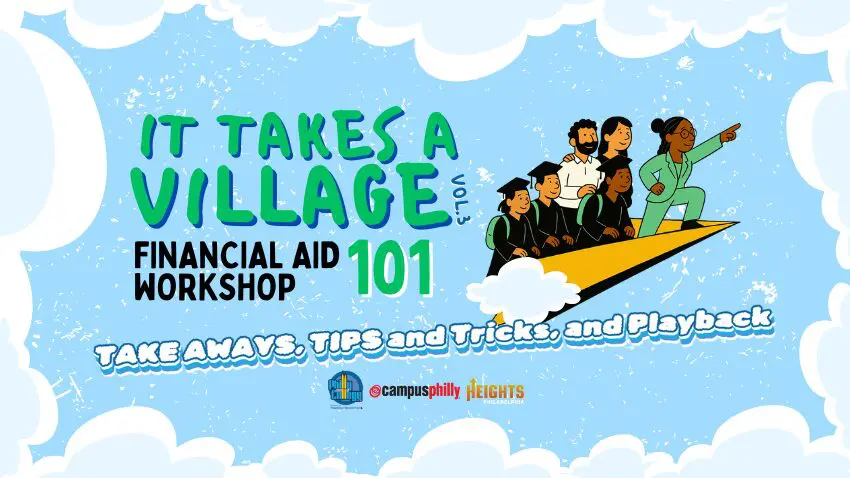
Key Takeaways From the “It Takes a Village” FAFSA Workshop
Key takeaways from our “It Takes a Village” workshop with Heights Philadelphia and Campus Philly
Filing the FAFSA can feel like one of the biggest hurdles standing between you and college. We get it — between confusing questions, tax forms, FSA IDs, and worrying about whether you’re doing it “right,” the whole process can be overwhelming.
That’s exactly why PhillyGoes2College partnered with Heights Philadelphia and Campus Philly last year to host “It Takes a Village: FAFSA 101” — a completely free virtual workshop designed to bring Philadelphia families, students, and counselors together in one place to learn how to navigate the financial aid process.
The mission of It Takes a Village? To dispel the worries, confusion, and barriers around FAFSA and everything post-secondary related by putting everyone on an even playing field with clear information, expert guidance, and real talk from people who’ve been there.
In December 2025, we welcomed approximately 30 guests who registered and attended this critical session. Our virtual room was filled with students, parents, grandparents, teachers, and counselors — all eager to learn more about how to handle FAFSA as graduation approaches in 2026.
We gathered some of Philadelphia’s top college access experts alongside current Temple University students who shared their real experiences navigating the FAFSA process. Below, we’re sharing the most important takeaways and practical tips from that workshop.
The 5 Most Important FAFSA Tips You Need to Know
1. FAFSA is Completely FREE — Don’t Get Scammed
The official FAFSA website is studentaid.gov — it MUST say .gov. If any website asks you to pay a fee to complete your FAFSA, close that browser tab immediately. It’s a scam.
Christina Boateng from Heights Philadelphia emphasized: “Make sure it’s the standard .gov link. As long as it says .gov on it for FAFSA, that’s the correct link.”
2. File Your Taxes BEFORE Completing FAFSA
This was the #1 lesson from Sarah Deangelis, a Temple University senior studying Community Education, who learned this the hard way. She shared: “I got genuinely thousands more dollars when it was prefilled rather than doing it myself.”
When your parents complete their taxes before filling out the FAFSA, you can use the IRS Data Retrieval Tool to automatically import all tax information directly into the form. This means faster processing, more accurate information, better financial aid packages, and less stress.
Sarah experienced this firsthand: “There was a noticeable difference not only in the amount of stress and time that it took me to apply, but also the amount of money that I got.”
What if your parents haven’t filed taxes? LaToya Winkfield from the Philadelphia Education Fund shared that there are free tax preparation services available through Temple University and other community organizations. Don’t let this be a barrier.
3. Write Down EVERY Single Password
Becky Commons from Community College of Philadelphia’s Catto Scholarship program said: “I really just want them to write down their password. That is such a huge thing that we run into all the time.”
Here’s what you need FSA IDs (federal student aid accounts) for:
- The student needs one
- Each parent needs one (if parents are divorced/separated, potentially both)
You can’t just reset these passwords easily. If you forget them, it can add weeks to your process while you wait for verification and account recovery.
Pro tip: Keep a dedicated notebook or secure digital file with ALL your college-related passwords.
4. Add ALL Your Schools to Your FAFSA (Even the “Maybes”)
You can list up to 20 schools on your FAFSA. Don’t hold back.
Christina Boateng explained: “Even if you’re unsure about a school, add it to your list. You can always remove schools later, but getting them on there early ensures financial aid packages are ready when acceptance letters arrive.”
Why this matters: Schools can’t prepare your financial aid package until you’re on their FAFSA list. If you wait until after you’re accepted to add a school, you’re creating unnecessary delays. Some schools have limited funding that goes to students with complete files first.
5. Deadlines Are Absolutely NON-NEGOTIABLE
Kris Robinson from the School District of Philadelphia’s Office of Post-Secondary Readiness didn’t sugarcoat this: “Some of those deadlines that are coming from the federal government — it’s not the same thing as turning a paper in late. If you miss those dates, you are in a terrible financial circumstance.”
Missing FAFSA deadlines can cost you thousands in Pell Grants, Pennsylvania State Grant money, institutional scholarships from your school, and priority consideration for work-study positions.
Action step: Go to each school’s financial aid website and write down their FAFSA priority deadline. Put it on your phone calendar with multiple reminders.
Understanding What FAFSA Actually Unlocks
Madeline Birkner, Senior Manager of Persistence at the Philadelphia Education Fund, explained it this way: “FAFSA really is that first domino that’s going to kick off this process.”
FAFSA is the gateway that unlocks access to:
Federal Pell Grants — Free money you never have to repay (up to $7,395 for 2024-25)
Pennsylvania State Grants (PHEAA) — Significant funding if you’re staying in Pennsylvania, but you MUST file FAFSA first before you can even apply for state money.
Institutional Scholarships — Money directly from your college. Most schools require FAFSA on file before they’ll award their own scholarships.
Federal Work-Study — Earn money through on-campus jobs. Alexa Levitan, a CampusPhilly Street Team member and Temple senior studying social work, shared: “I was able to find a work study job on campus that paid me, and I at least knew the allotted amount they gave me would be the minimum of what I’d be getting that semester.”
Private Scholarships — Many scholarship programs (including the Philadelphia Education Fund’s scholarships) require proof you filed FAFSA before they’ll award you money.
Federal Student Loans — If you need to borrow, federal loans offer better protections and lower interest rates than private loans. But as Alexa noted: “You don’t need to choose the full amount. Make sure to look at the numbers and what it’s actually asking.”
Handling Complicated Family Situations
One of the most valuable parts of the workshop was addressing the real, messy family situations that don’t fit neatly into FAFSA’s questions.
Divorced or Separated Parents
Becky Commons explained: “There is a question on the FAFSA where it asks if your biological parents are still together or if they’re separated. If they’re separated, it asks if one parent provides more support than the other.”
The easiest path: If one parent clearly provides more financial support, answer “yes” and only provide information for that one parent. In 50/50 custody situations, you’ll likely need both parents’ information.
Stepparents
The key distinction: “That’s my mom’s boyfriend” vs. “My mom is married to him”
- Boyfriend/partner who isn’t legally married? No need to include them.
- Legally married stepparent? They must be included if they file taxes jointly with your parent.
As Becky shared: “If your mom is remarried and files taxes jointly with your stepdad, the stepdad’s income has to be on there — even if he’s not interested in being on the FAFSA.”
Living with Grandparents or Guardians
FAFSA only cares about parents — unless your grandparent or guardian legally adopted you, in which case they ARE your parent for FAFSA purposes.
If you’re living with a grandparent who hasn’t legally adopted you, they typically won’t go on your FAFSA. This can sometimes create complicated situations that require reaching out directly to your school’s financial aid office.
Remember: Kris Robinson emphasized that you have power as a consumer. If your financial aid offer doesn’t accurately reflect your ability to pay, speak up. Financial aid offices can make adjustments for special circumstances, but only if you advocate for yourself.
What to Gather BEFORE You Start Your FAFSA
Madeline Birkner from the Philadelphia Education Fund had practical advice: “To me, FAFSA is a laptop activity. I want the full keyboard. I don’t want autocorrect involved.”
Documents You’ll Need:
- ✅ Social Security card (for student and parents)
- ✅ Driver’s license or state ID
- ✅ Tax returns (for the appropriate year)
- ✅ W-2 forms
- ✅ Records of untaxed income
- ✅ Parent email addresses
- ✅ List of schools you’re considering (even the maybes!)
Set Up Your Environment:
- Use a laptop (not your phone)
- Have your phone nearby for verification codes
- Set aside 1-2 hours of uninterrupted time
- Have a parent available if you’re dependent
Why FAFSA is Worth the Effort
LaToya Winkfield, Vice President of Administration, Finance and Operations at the Philadelphia Education Fund, framed it perfectly:
“This is a business decision you’re making. You are a consumer of your college experience. You get to make a choice of where you want to spend your dollars, and this is part of you taking an action step towards making that purchase of your college education.”
And here’s the best news that both students shared: It gets easier.
Alexa Levitan reassured everyone: “The first FAFSA definitely takes the most time and can be stressful, but it will get easier after the first initial one. Everything is in there, and it goes way faster.”
The second year? Maybe 30 minutes. By year three, you’ll breeze through it.
Common FAFSA Myths — BUSTED
Myth #1: “FAFSA is only for four-year colleges”
Reality: FAFSA covers community colleges (like CCP), trade schools (like Lincoln Tech), and certificate programs — not just four-year universities.
Myth #2: “FAFSA is a scholarship program based on grades”
Reality: Madeline Birkner clarified this during the workshop: “The first time a student fills out FAFSA as a brand new student, you pretty much just need proof of high school graduation. Your GPA could be a 1.0. And if a school admitted you and you enroll there, you could qualify for aid.”
However, you DO need to maintain satisfactory academic progress (typically a 2.0 GPA and passing two-thirds of your credits) to keep receiving aid in future years.
Myth #3: “If I make a mistake, I’m screwed”
Reality: There’s a corrections process! Becky Commons emphasized: “There can always be adjustments made if needed along the way. You just have to ask about it.”
Myth #4: “My parents don’t want me to see their income”
Reality: With the new FAFSA, parental financial information is completely censored from the student. Parents complete their section privately, and students never see the actual numbers unless parents choose to share them.
Myth #5: “FAFSA is too complicated and overwhelming”
Reality: Madeline Birkner offered this reassurance: “FAFSA has become so much more simplified since I first started helping students 11 years ago.” The process continues to improve, making it more accessible for families.
Your FAFSA Action Plan
STEP 1: Create Your FSA IDs (Both Student & Parent)
- Go to studentaid.gov
- Click “Create Account”
- Complete verification process
- Write down your username and password immediately
- Have your parent(s) do the same
STEP 2: Gather Your Documents
Social Security cards, tax returns, W-2 forms, list of schools
STEP 3: File Taxes (If You Haven’t Already)
Look into free services through Temple University or community organizations. This will save you THOUSANDS in better financial aid.
STEP 4: Complete Your FAFSA
- Use your laptop with your phone nearby for codes
- Have a parent available
- Use the IRS Data Retrieval Tool if possible
- Add ALL schools you’re considering
- Submit!
STEP 5: Monitor Your Email & Advocate for Yourself
- Schools will send financial aid award letters
- Check your student portal regularly
- If your financial aid package doesn’t feel right, reach out to the financial aid office
Resources & Support from Our Partners
Heights Philadelphia
Personalized support with FAFSA, college applications, or navigating the entire post-secondary process through their Step Up to College program.
🔗 Website: heights.org
📖 Step Up to College Guide: heights.org/our-programs/college/step-up-to-college
📱 Instagram: @HeightsPhilly
👥 Facebook: /HeightsPhilly
🎵 TikTok: @HeightsPhiladelphia
PhillyGoes2College
Scholarships, student success stories, financial literacy content, and the I AM PHL Contest.
🔗 Website: phillygoes2college.org
📱 Instagram: @phillygoes2college_
📺 YouTube: PhillyGoes2College
Campus Philly
Internships, jobs, and professional development opportunities in Greater Philadelphia. Interested in joining the Street Team like Alexa?
🔗 Website: campusphilly.org
📱 Instagram: @campusphilly
💼 Career Hub: campusphilly.org/employers-partners/career-hub
Official FAFSA Resources:
- File Your FAFSA: studentaid.gov
- PA State Grant (PHEAA): pheaa.org
- Free Tax Prep: Temple University and community organizations
What “It Takes a Village” Is All About
The college access journey shouldn’t feel like something you have to figure out alone. That’s the core belief behind our partnership with Heights Philadelphia and Campus Philly to create the “It Takes a Village” workshop series.
This completely free virtual workshop series brings Philadelphia families, students, and counselors together in one space — creating an environment where families can ask questions without judgment, students can hear from peers who’ve navigated the same challenges, and everyone leaves feeling more confident about the path ahead.
Our December 2025 FAFSA workshop welcomed approximately 30 attendees representing the full spectrum of the Philadelphia education community. Students preparing for graduation in 2026 sat alongside their parents and grandparents. Teachers and counselors joined to better support their students. Everyone came with one goal: to understand how to handle FAFSA as graduation approaches.
Why These Three Organizations?
PhillyGoes2College — Your digital hub for scholarships, financial literacy, college success stories, and the I AM PHL Contest celebrating local student talent.
Heights Philadelphia — Empowering Philadelphia youth through mentorship, education programs, and comprehensive college access support.
Campus Philly — Connecting diverse college students and recent graduates with opportunities to explore, live, and thrive in Greater Philadelphia.
The mission of It Takes a Village? Everyone deserves access to clear, accurate information about paying for college — not just students whose parents went to college or who attend well-resourced schools. We’re leveling the playing field.
What’s Next in the “It Takes a Village” Series?
This FAFSA workshop is just the beginning. “It Takes a Village” will continue bringing Philadelphia families, students, and counselors together for future completely free virtual sessions in 2026.
Want to attend future workshops? Follow PhillyGoes2College, Heights Philadelphia, and Campus Philly on social media to stay updated on upcoming sessions.
You’re Not Alone in This
Whether you attended our December workshop or you’re just finding this information now, know that you’re not alone in this journey.
Reach out to any of our organizations for support. Check out our websites. Follow us on social media. Show up to our workshops when we announce them. It truly does take a village — and we’re yours.
Together, we’re breaking down barriers to college access in Philadelphia — one workshop, one student, one family at a time. 💙💛
Watch the Full Workshop Recording
If you attended our December 2025 “It Takes a Village: FAFSA 101” workshop and would like to revisit the full conversation, the complete recording is available below for all registered attendees.
The 43-minute workshop includes expanded discussions on complicated family situations, real-time Q&A from attendees, and additional insights not covered in this blog post.
Featured in this workshop:
- Madeline Birkner, Senior Manager of Persistence, the Philadelphia Education Fund
- Kris Robinson, Program Coordinator, the School District of Philadelphia
- Christina Boateng, College Access and Equity Coordinator, Heights Philadelphia
- LaToya Winkfield, Vice President of Administration, Finance and Operations, the Philadelphia Education Fund
- Becky Commons, Manager of Aid and Eligibility for the Catto Scholarship, Community College of Philadelphia
- Sarah Deangelis, Temple University Senior studying Community Education
- Alexa Levitan, CampusPhilly Street Team Member and Temple University Senior studying Social Work
This recording is available to all registered attendees of the 2025 “It Takes a Village” workshop series.
Have questions or want to share this with someone who needs it? Forward this post to students and families navigating the college access process.
