

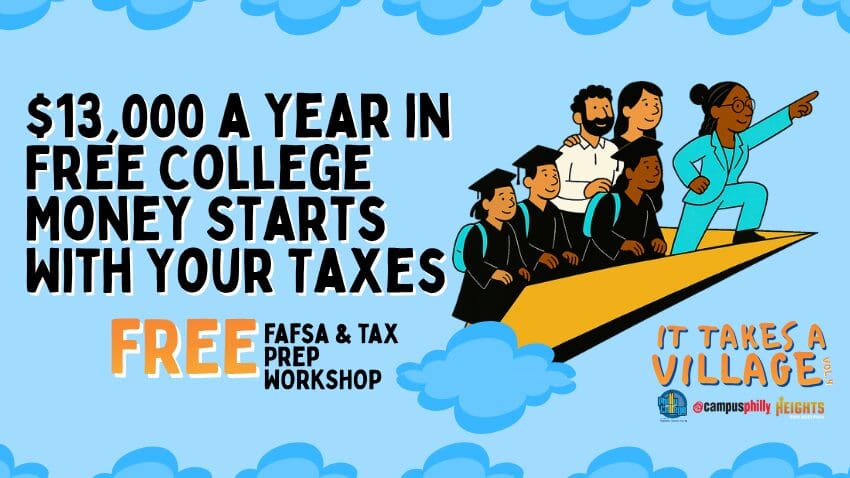
$13,000 a Year in Free College Money Starts With Your Taxes — Here’s How Philly Families Can Claim It
There’s up to $13,145 a year available in federal and state financial aid for college. It doesn’t go to the students who need it most by default — it goes to the students whose families filed their taxes.
That’s the real talk Jonathan Holbert from Heights Philadelphia brought to It Takes a Village Vol. 4, and it’s the kind of thing nobody in high school tells you until it’s too late.
Good news: you’re hearing it now. Watch the full session below, then keep reading for everything you need to know about how taxes and the FAFSA work together — and where to get both done for free right here in Philly.
👩🏾🎓 A Student’s Real Story: $4,000 vs. Nothing
Before the slides, Rachel from Heights Philadelphia handed the mic to Sarah — a Temple University senior and Heights intern who has done the FAFSA every single year she’s been in college.
Her message was simple and worth every second:
Two years, her dad filed his taxes on time. Two years, he didn’t. The difference? $4,000 in grants both years taxes were filed on time. Zero one year. About $1,500 the other.
Same student. Same family. The only variable was whether the taxes were done.
“It makes everything so much easier,” Sarah said. “It goes from a several-hour, maybe several-day process down to 30 minutes, if that.”
That’s not a technicality. That’s real money — free money — that families are leaving behind every year without realizing it.
📋 Why the FAFSA Matters in the First Place
The FAFSA — Free Application for Federal Student Aid — is the only way to access federal and state financial aid for college. Without it, you’re not in the running, period.
In Pennsylvania right now, the maximum combined amount a student could receive per year from federal and state sources is $13,145. That includes the Pell Grant and the Pennsylvania state grant (FIA). And that number is per student, not per household — meaning if you have two kids heading to college, that’s up to $26,000 a year sitting on the table.
On top of federal and state money, many colleges use your FAFSA to determine whether you qualify for their own need-based institutional aid. Skipping the FAFSA doesn’t just cost you government grants — it could cost you school-specific scholarships and awards too.
🔗 So What Do Taxes Have to Do With It?
Everything.
The FAFSA uses your tax information to determine your income level, assets, and financial need. Specifically, it uses what’s called “prior prior year” taxes — which means one tax year, but from two years ago. Here’s how that breaks down:
- Senior applying for fall 2026: uses 2024 tax information
- Junior applying for fall 2027: uses 2025 tax information (what you’re likely filing right now)
- Once in college: the same logic applies every year — each new FAFSA uses taxes from two years prior
The reason it works this way is simple: the FAFSA wants verified data, not estimates. Two-year-old taxes are already on file with the IRS, which is how the magic happens.
The “Magic Button”
If you filed your taxes on time, here’s what the FAFSA experience looks like: you click one button that says the IRS can share your tax information with the Department of Education, and the entire form fills itself in. Done. Verified. Clean.
If you didn’t file on time? You’re doing it manually — hunting down line items on your 1040, typing in numbers yourself, hoping you don’t make a typo. And here’s the kicker: if you manually enter your data, every single college you apply to will require you to submit verification documents. That’s a hard deadline you’ll have to hit with W-2s and 1040s in hand.
📁 What Documents Do You Actually Need?
Even if the FAFSA auto-fills from the IRS, Jonathan strongly recommends keeping these on hand — because colleges may ask for them during verification:
- W-2s from your employer(s)
- 1040 (your main federal tax return)
- 1099s (for self-employment or gig work)
- Any untaxed income documentation — child support, veterans benefits, gifts over $10,000, etc.
Keep everything in one place. The FAFSA auto-fill might mean you never open the folder — but if a school asks for verification with a hard deadline, you’ll be glad it’s there.
🚧 Common FAFSA Barriers — And How to Navigate Them
What If You Haven’t Filed Your Taxes?
First: don’t panic. Not everyone is required to file taxes — there’s an income threshold. But if you’re above it, you need to file. If you missed it, file now, then go do the FAFSA manually with your 1040 in hand. You don’t need to wait for anything from the IRS — just use the numbers directly from your tax return.
What If You Were Paid in Cash?
If your income is above the filing threshold, you’re required to file taxes — regardless of how you were paid. Cash, check, Venmo, whatever. The FAFSA will ask income questions that will flag it if something doesn’t add up, so it’s better to file correctly upfront than deal with the fallout later.
What If My Financial Situation Has Changed Since the Tax Year?
This comes up more than people think. Say you’re paying a 2026 college bill using 2024 income information — but you lost a job in 2025. You can contact individual colleges directly and explain your current financial circumstances. Schools have professional judgment processes for exactly this situation. Use them.
Citizenship Status
As long as the student is a U.S. citizen or eligible non-citizen (including green card holders), the FAFSA process is the same regardless of parents’ status. Legally, information provided to the Department of Education can only be used by the Department of Education — there are laws protecting it from being shared with other agencies. Jonathan was direct about this: filing the FAFSA doesn’t add any additional exposure beyond what’s already shared when filing taxes with the IRS.
That said, this is a personal decision. Talk to someone you trust — a school counselor, a Heights staff member, or another professional — before making the call.
Separated or Divorced Parents
Use financial information from whichever parent provided the most financial support in the last 12 months. If the student splits time between two homes, it’s typically the parent they lived with most. At least one biological parent’s information is required on the FAFSA — unless the student has a legal guardian with formal documentation.
If a student is living with a grandparent or other family member without a formal legal guardianship arrangement, this can get complicated. Don’t try to navigate it alone — reach out to Heights, a school counselor, or another college access advisor for guidance.
529 Accounts
If you have a 529 savings account (an education-specific savings account with tax benefits), yes — the FAFSA will ask about it. The good news: 529 assets are counted at a lower rate than other savings, so they won’t hurt your aid eligibility as much as a regular savings account would. One strategy worth knowing: if a grandparent owns the 529 (not a parent), it may not count on the FAFSA at all. Talk to a financial aid advisor about whether this applies to your situation.
💸 Free Tax Prep in Philly — No Excuses
One of the biggest reasons families don’t file taxes on time? Cost. A tax preparer can run you hundreds of dollars depending on your situation.
Campaign for Working Families VITA program takes that excuse off the table entirely.
VITA stands for Volunteer Income Tax Assistance, a program funded by the IRS that provides completely free tax preparation. Campaign for Working Families is the largest VITA provider in the greater Philadelphia area — and they served more than 36,000 clients last year.
Here’s what they offer:
- Free tax prep — in person, drop-off, or fully virtual (no need to leave home)
- Prior year returns going back up to 5 years — yes, they can help you catch up
- Amendments — if your return needs to be corrected
- Low Income Tax Clinic (LITC) — free IRS dispute resolution (the same thing those “Optima Tax Relief” ads charge thousands for)
- Match Savings Program — partnered with Vanguard, they’ll match your savings toward tuition, emergency funds, or a home purchase. Spots are limited, so get in early.
Income guideline is around $67,000/year, but Campaign for Working Families does not turn people away — so don’t let that number stop you from reaching out.
🔗 Visit cwfphila.org to schedule an appointment or learn about drop-off and virtual options.
🤝 You Don’t Have to Figure This Out Alone
Jonathan said it best: “Don’t ever feel like you have to suffer in silence and figure this out yourself.”
Heights Philadelphia has staff embedded in schools across Philly. PhillyGoes2College has resources online for every step of the college access journey. Campus Philly supports college-going students with career and life resources across the city. And Campaign for Working Families has free tax and financial support ready to go.
Every organization in this session exists because Philly students and families deserve real support — not just a website link and a wish of luck.
📚 Resources to Use Right Now
Campaign for Working Families (Free Tax Prep — VITA) Free in-person, drop-off & virtual tax prep | Prior year returns | Amendments | IRS dispute help | Match savings program 🔗 cwfphila.org
FAFSA — Free Application for Federal Student Aid 🔗 studentaid.gov
Heights Philadelphia — College Access & Advising 🌐 heights.org | Step Up to College Guide 📸 @HeightsPhilly | 👍 /HeightsPhilly | 🎵 @HeightsPhiladelphia
PhillyGoes2College — Scholarships, Financial Aid & College Planning 🌐 phillygoes2college.org | 📸 @phillygoes2college_ | 📺 YouTube
Campus Philly — College Life & Careers in Greater Philadelphia 🌐 campusphilly.org | 💼 Career Hub | 📸 @campusphilly
🏫 About It Takes a Village
It Takes a Village is a free virtual event series for Philly high school students, college students, and families — hosted by PhillyGoes2College, Heights Philadelphia, and Campus Philly. Each session brings in real experts to answer real questions about paying for college and planning your future.
Stay connected for upcoming sessions — and make sure you’re on the mailing list.
This blog post is a companion resource to the It Takes a Village Vol. 4 webinar. It is for informational purposes only. For guidance specific to your situation, connect with Heights Philadelphia, PhillyGoes2College, or a qualified college access advisor.
