

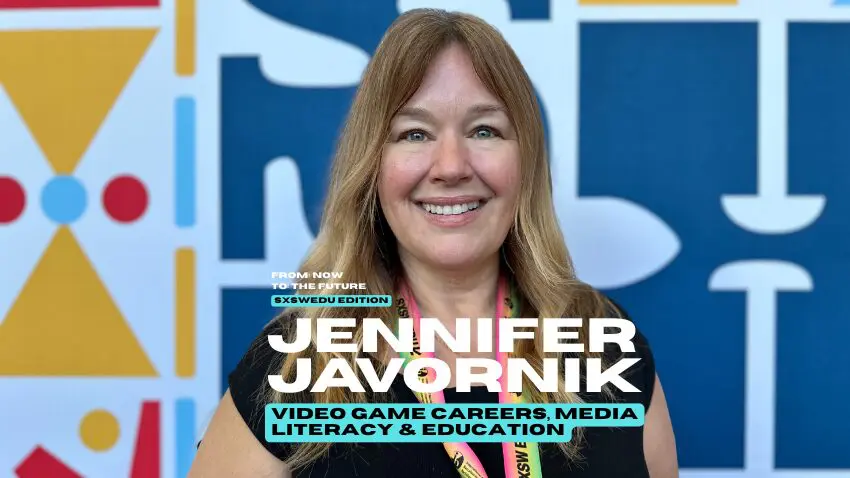
Video Game Careers, Media Literacy & Education: Jennifer Journick’s Path from Theater to Tech
This past spring at SXSW EDU, PhillyGoes2College sat down with Jennifer Journick, Chief Partnerships Officer at Filament Games, a studio that creates video games for positive impact—from education to mental health to nonprofit campaigns.
In our conversation, Jennifer broke down how games can teach media literacy, what careers exist in the gaming world, and why students shouldn’t be afraid to start by simply doing what they love.
Using games to teach media literacy in an AI world
Jennifer’s SXSW EDU panel focused on media literacy and games—a topic that feels more urgent than ever.
With AI-generated videos, deepfakes, and misleading content spreading quickly online, many teens are starting to say things like, “I don’t trust any news. It’s all fake.”
Jennifer shared why games are a powerful way to push back against that feeling:
-
Games give students hands-on practice investigating where information comes from.
-
Players can test whether something is trustworthy, not just hear about it in a lecture.
-
Students can build habits like checking sources, comparing outlets, and asking, “Is this real?”
She suggested even simple starting points for parents and educators—like comparing how five different news outlets cover the same story—to help students see bias, perspective, and patterns.
From theater major to tech and video games
Jennifer’s own education journey is a great example for students who don’t have everything “figured out.”
She:
-
Went to Dartmouth College, starting undeclared
-
Majored in theater because she loved performing and storytelling
-
Later worked in IT consulting around the Y2K era
-
Earned a Master of Science in Information Technology at Northwestern while working full-time
She didn’t plan to end up in video games—but along the way she realized she loved:
-
Stories and performance (theater, improv, acting)
-
Technology and problem solving (coding felt like puzzles)
Video games turned out to be the place where both could live together:
storytelling + tech + impact.
It’s a reminder to students that your major doesn’t lock you into just one job. Skills and interests can combine in unexpected ways later.
“Just start” – her advice to students
Jennifer’s biggest message to students who feel stuck or overwhelmed?
Don’t wait to be perfect. Just start.
She encouraged students to:
-
Use after-school time and projects to try things
-
Stop comparing themselves to people online who seem “way ahead”
-
Remember that every step is about momentum, not a lifelong contract
You don’t need to know your entire 10-year plan. You just need to move toward what you’re curious about and let the next step reveal itself.
Careers in video games: more than just coding
Jennifer also broke down the wide range of careers in the video game world—especially helpful for students who love games but don’t know where they might fit.
Some roles she highlighted:
🎮 Game Producer (Project Manager)
-
Keeps the team on schedule and on budget
-
Coordinates art, coding, design, and testing
-
Great for students who like organizing, planning, and leading projects
🧠 Game Designer
-
Comes up with the rules, levels, and play experience
-
Writes and refines the game’s systems and storytelling
-
Strong fit for students who love writing, strategy, and ideas
🎨 Game Artist (2D or 3D)
-
Designs characters, worlds, and visual styles
-
Needs lots of practice drawing from different angles and copying styles so a team can match the same look
🖱️ UX (User Experience) Designer
-
Sits between art and engineering
-
Designs buttons, menus, and layouts so players can navigate easily
-
Good for students who like both creative work and tech
💻 Game Engineer / Programmer
-
Writes the code that makes the game function
-
Can start with beginner tools and move into engines like Unity or Unreal
And beyond development, she reminded us that the industry also needs:
-
Marketing and advertising
-
HR and recruiting
-
Event planners and esports organizers
If a student loves events, sports, or promotion but also loves games, they might find a home in esports management, marketing, or community work.
What students can do right now
Jennifer suggested a few practical ways students can start building skills today:
-
Make simple board or card games with friends
-
Join or start a game club at school
-
Explore free online tools to learn coding or design
-
Play different kinds of games—not just one—to study how they’re built
The goal isn’t to create a perfect game on the first try—it’s to learn by doing and discover what excites you most.
Watch the full interview
Hear the full conversation with Jennifer Journick from Filament Games at SXSW EDU and share it with students who love games, storytelling, or tech:
